A closer look at where brand distinctiveness truly lives when optimization becomes table stakes.
In a recent TED Talk, Vinciane Beauchene asked a provocative question: If AI could take over all your team’s tasks tomorrow, who would you keep – and why? The talk reframes the “Will AI take our jobs?” anxiety, but as a marketer, that made me think of another question: If you removed your humans tomorrow, would your customers care… and why?
AI is rapidly becoming excellent at functional execution. It can optimize pricing, personalize recommendations, automate workflows, generate content, and coordinate across systems without fatigue. In many industries, that covers a surprising share of what we traditionally think of as marketing work. When everyone can execute at that level, functional excellence stops being a differentiator. And when optimization becomes table stakes, what makes customers choose you?
To answer that, it helps to step back and look at value in layers. Every company competes across three levels:
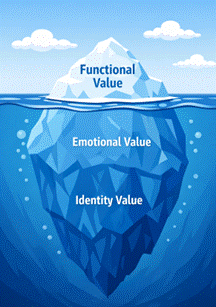
- Functional value – speed, convenience, price, performance
- Emotional value – how the experience makes customers feel
- Identity value – what choosing you says about them
AI will compress functional advantages first. It will increasingly simulate emotional ones. The real strategic question is: where does your identity and trust equity live?
Let’s look at Costco as an example. At first glance, Costco looks purely functional. Low prices. Tight SKU selection. Supply chain efficiency. Those are all areas where AI can and will optimize aggressively.
But look deeper: emotionally, Costco creates the thrill of discovery. The treasure hunt effect. The feeling that you are getting access to something special and well curated. Customers feel smart shopping there. They feel protected from being ripped off.
At the identity layer, it goes further. Being a Costco member signals something. You are savvy. Practical. Not flashy, but informed. You belong to a tribe that values value. The membership card itself reinforces that identity.
Now imagine Costco becoming a perfectly frictionless, fully automated purchasing engine. No humans. No curated surprises. No in-store serendipity. Just optimized bulk fulfillment. It might be more efficient. But would it feel the same?
This is the risk many organizations face as they pursue AI. The danger isn’t that AI makes them worse. It’s that it makes everyone equally good at the functional layer, while unintentionally eroding the emotional and identity layers that drive loyalty.
Before automating aggressively, companies should ask:
- Where does our differentiation truly live?
- Which parts of our experience build emotional equity?
- Where does human presence increase trust?
- What would customers actually miss if it disappeared?
This isn’t a workforce exercise. It’s a customer understanding exercise. In the age of AI, the companies that win won’t simply automate more. They will automate wisely, while deliberately protecting and strengthening the human moments that anchor identity and trust.
If you’re exploring AI in your organization and want to understand where your differentiation truly lives across the functional, emotional, and identity layers, I’d be happy to talk about how we apply the Decoder Lens to uncover what your customers actually value – and what must stay human to protect it. Contact me at info at bureauwest.com.
Source: “Will AI take your job in the next 10 years? Wrong question,” Vinciane Beauchene, TED@BCG, October 2025