A small paradox at the heart of customer research – and what it reveals about how people really make decisions
Over the past few decades, behavioral economics and behavioral science have shown something most researchers recognize immediately: people don’t fully understand the true drivers of their decisions.
Yet in customer research, we often design our questions as if rational explanations will reveal the answer. Ask someone why they chose a particular product and the response usually sounds perfectly logical: “Price.” “Features.” “Convenience.” “A good deal.”
Those explanations aren’t necessarily wrong. But they’re rarely the whole story. I remember an interview years ago with a woman who told me she would never switch car brands. When I asked why, she talked about reliability, resale value, and service quality. It sounded like a textbook rational decision.
Then, almost as an afterthought, she added: “It was the first car I bought after my divorce. It made me feel like I could start over.”
In that moment the decision made sense – not because of the features, but because of what the purchase meant to her. She wasn’t really buying transportation. She was buying a sense of independence and renewal.
Moments like that happen constantly in qualitative research. Participants explain their choices in rational terms, yet the emotional driver of the decision emerges indirectly – in stories, metaphors, or moments that seem almost incidental.
The interesting question isn’t why decisions are emotional. Behavioral science has demonstrated that repeatedly. The more interesting question is why people so often describe those decisions in rational language.
Part of the answer, I’ve come to believe, is cultural. In the United States especially, people feel a strong pressure to present themselves as confident, rational, and self-directed. Decisions are expected to look intentional and logical, even when the deeper motivations are emotional. So when we ask people why they chose something, the answer we hear is often the explanation that feels most acceptable to say out loud.
Over years of research interviews, I began to notice that participants were often answering a different question than the one I had asked.
This dynamic doesn’t just affect research interviews. It shapes how insights get interpreted inside organizations. When customer explanations sound rational, teams often focus on functional improvements – better features, lower prices, more convenience. But if the real driver of the decision is emotional or cultural, those improvements may miss what actually matters to customers.
When we ask, “Why did you choose this?” the answer might really be responding to a deeper, unspoken question such as:
- Will this make me feel competent?
- Does this reflect the kind of person I want to be?
- Will people like me choose this too?
Those hidden questions often explain far more about a decision than the rational explanation that appears on the surface.
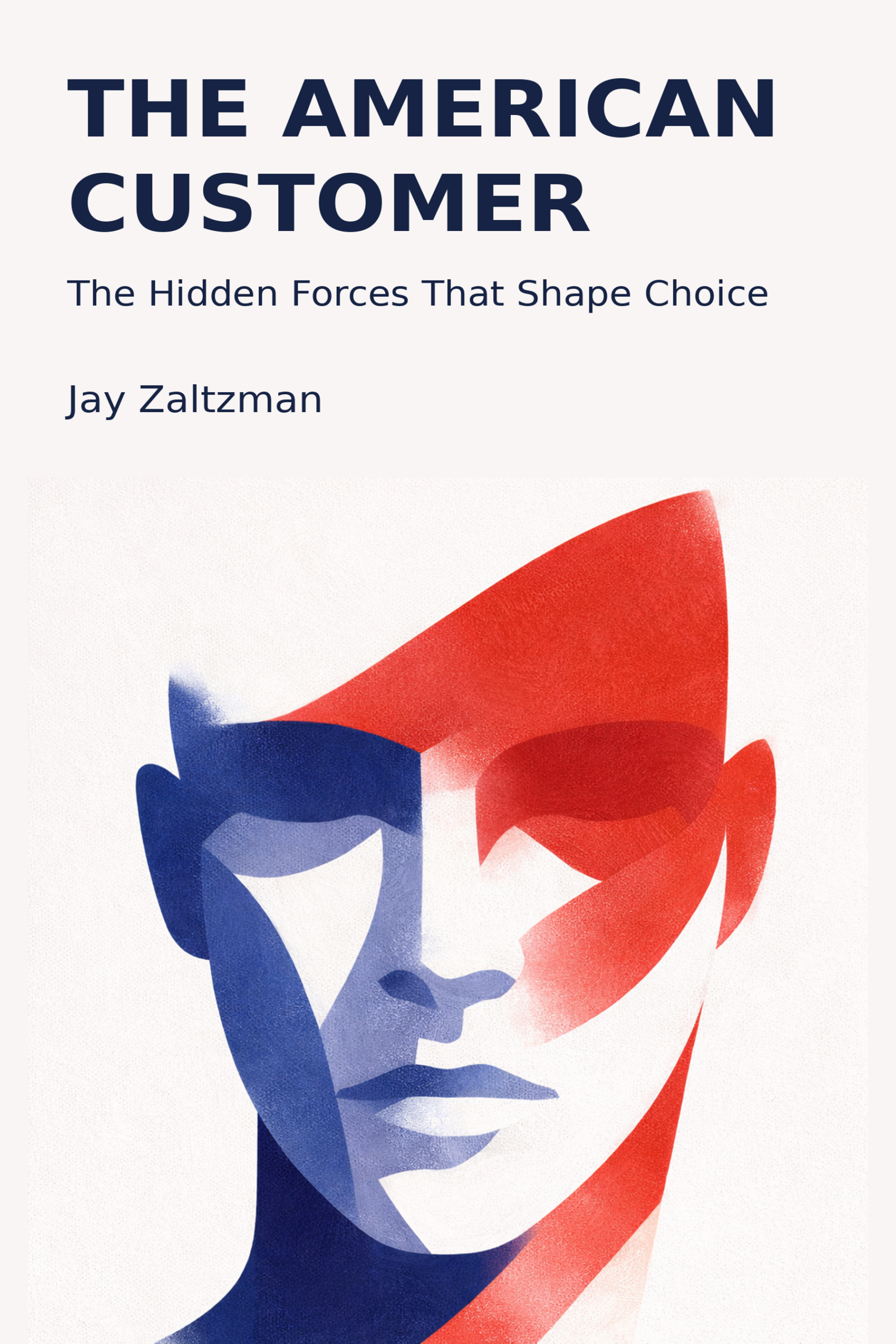
Seeing that pattern repeatedly led me to write a short book I’ve just finished: The American Customer: The Hidden Forces That Shape Choice.
The book explores how cultural stories – about independence, reinvention, belonging, and possibility – shape the way American customers interpret their decisions and explain them to others. It also introduces a few practical lenses I’ve found useful for decoding motivations that participants don’t always articulate directly.
The book will be published in late March, 2026. I’m especially interested in whether the ideas resonate with your own experience in research or marketing. If you have thoughts, questions, or reactions, I’d love to hear them. Contact me at info at bureauwest.com.