On ambiguity, ignorance, imagination – and the limits of AI.
I had the opportunity to interview Gerald Zaltman – creator of ZMET and one of the leading voices in uncovering the non-conscious drivers of thought and behavior – about his new book, Dare to Think Differently. (Note: we’re not related… as far as we know!)
Jerry told me the impetus for the book came from his interest in how people approach ill-structured or messy problems – the kinds of problems we and our clients deal with every day.
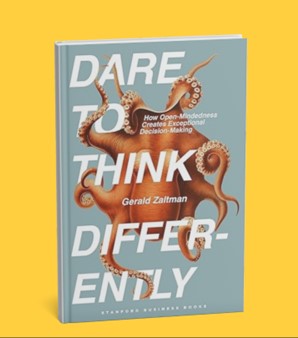
Here are four ideas that stood out as especially relevant for leaders, strategists, and insights professionals:
1. Embracing ambiguity
Jerry offered a deceptively simple idea: The primary job of a mind is to make meaning out of ambiguity.
We often treat ambiguity as a problem to eliminate. In strategy sessions and debriefs, the pressure is to “get clarity” quickly. But ambiguity is often where the opportunity lives. It’s where:
- The next product idea is hiding
- The overlooked emotional tension sits
- The unexamined assumption operates
For those of us in insight roles, our job isn’t to prematurely tidy ambiguity. It’s to help organizations sit with it long enough to extract meaning.
2. Ignorance is where competitive advantage lives
Jerry said, “Ignorance is where the next competitive advantage is dwelling.”
Most organizations treat ignorance as something to conceal. In healthy cultures, it’s something to surface. When something feels unclear in a category or customer journey, that fog may be signal, not noise.
A few practical questions this suggests:
- What are we missing?
- What assumption are we not aware we’re making?
- What piece of information would make this puzzle clearer?
Those questions alone can change how research is commissioned and how findings are used.
3. Imagination comes before creativity
Jerry drew a distinction I found clarifying:
- Imagination is seeing what’s missing.
- Creativity is making that idea workable.
We often treat creativity as the main event. But in his framing, creativity is an off-ramp from imagination – what makes an idea practical or executable.
Imagination comes earlier. It’s the ability to picture what could fill the gap in an ambiguous situation – to see what we don’t yet fully understand. Without imagination, creativity has nothing solid to build on.
For those of us working in research and strategy, that’s a useful reminder: before refining the solution, we have to ensure we’ve identified what’s actually missing.
Imagination requires sitting with ambiguity long enough to notice the gap – and that may be the harder discipline.
4. Thinking “like” vs. thinking “as” – the AI Question
Our conversation also turned to AI. Jerry described the difference between thinking “like” and thinking “as.”
AI can help us think like something – simulate patterns, accelerate analysis, generate language. But thinking as a human involves embodied, constantly shifting cognition that shapes imagination and meaning.
His warning was clear: AI can augment imagination and creativity, but it cannot replace them. The risk isn’t using AI – the risk is outsourcing imagination.
Taken together, these ideas are about ownership of thinking. Ownership shows up in how you:
- Stay with ambiguity instead of rushing to clarity
- Surface ignorance instead of hiding it
- Strengthen imagination before jumping to execution
- Use AI as a tool without surrendering judgment
When I asked Jerry why someone should read the book, he resisted giving a conventional benefit statement. Now I understand why. The book doesn’t hand you conclusions. It sharpens your ability to reach better ones.
You can watch the full interview here: https://www.youtube.com/watch?v=8H75GE1O91w
If you’re wrestling with an ill-structured problem and want to turn ambiguity into meaningful direction, I’d welcome a conversation. Contact me at info at bureauwest.com.
Sources: “From Insight to Impact: Interview with Gerald Zaltman,” 2/24/26; “Dare to Think Differently: How Open-Mindedness Creates Exceptional Decision-Making,” Gerald Zaltman, 2/24/26