When AI Optimizes Everything, What Makes a Brand Different?

A closer look at where brand distinctiveness truly lives when optimization becomes table stakes.

In a recent TED Talk, Vinciane Beauchene asked a provocative question: If AI could take over all your team’s tasks tomorrow, who would you keep – and why? The talk reframes the “Will AI take our jobs?” anxiety, but as a marketer, that made me think of another question: If you removed your humans tomorrow, would your customers care… and why?

AI is rapidly becoming excellent at functional execution. It can optimize pricing, personalize recommendations, automate workflows, generate content, and coordinate across systems without fatigue. In many industries, that covers a surprising share of what we traditionally think of as marketing work. When everyone can execute at that level, functional excellence stops being a differentiator. And when optimization becomes table stakes, what makes customers choose you?

To answer that, it helps to step back and look at value in layers. Every company competes across three levels:
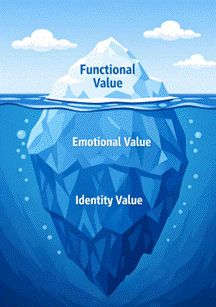
  • Functional value – speed, convenience, price, performance
  • Emotional value – how the experience makes customers feel
  • Identity value – what choosing you says about them

AI will compress functional advantages first. It will increasingly simulate emotional ones. The real strategic question is: where does your identity and trust equity live?

Let’s look at Costco as an example. At first glance, Costco looks purely functional. Low prices. Tight SKU selection. Supply chain efficiency. Those are all areas where AI can and will optimize aggressively.

But look deeper: emotionally, Costco creates the thrill of discovery. The treasure hunt effect. The feeling that you are getting access to something special and well curated. Customers feel smart shopping there. They feel protected from being ripped off.

At the identity layer, it goes further. Being a Costco member signals something. You are savvy. Practical. Not flashy, but informed. You belong to a tribe that values value. The membership card itself reinforces that identity.

Now imagine Costco becoming a perfectly frictionless, fully automated purchasing engine. No humans. No curated surprises. No in-store serendipity. Just optimized bulk fulfillment. It might be more efficient. But would it feel the same?

This is the risk many organizations face as they pursue AI. The danger isn’t that AI makes them worse. It’s that it makes everyone equally good at the functional layer, while unintentionally eroding the emotional and identity layers that drive loyalty.

Before automating aggressively, companies should ask:

  • Where does our differentiation truly live?
  • Which parts of our experience build emotional equity?
  • Where does human presence increase trust?
  • What would customers actually miss if it disappeared?

This isn’t a workforce exercise. It’s a customer understanding exercise. In the age of AI, the companies that win won’t simply automate more. They will automate wisely, while deliberately protecting and strengthening the human moments that anchor identity and trust.

If you’re exploring AI in your organization and want to understand where your differentiation truly lives across the functional, emotional, and identity layers, I’d be happy to talk about how we apply the Decoder Lens to uncover what your customers actually value – and what must stay human to protect it. Contact me at info at bureauwest.com.

Source: “Will AI take your job in the next 10 years? Wrong question,” Vinciane Beauchene, TED@BCG, October 2025


“We’re in the business of influencing other people”

When insight fails, it’s rarely because the research was wrong. More often, it’s because the insight never quite fit how decisions actually get made inside the organization.

That reality came through clearly in my recent From Insight to Impact video interview with Jinghuan Liu Tervalon, a senior marketing and insights leader with deep experience across CPG, food and beverage, and omnichannel retail. Her perspective offered a useful reminder: the value of research and the value of the research partner are tightly intertwined.

  • For Jinghuan, truly valuable research is first and foremost actionable – but not in the abstract sense the word is often used. In practice, that means explicitly tying insights to growth strategy and translating high-level ambition into concrete business terms. Growing penetration, for example, only becomes actionable when it’s reframed as a specific number of households, regions, or behaviors the organization can rally around.
  • She also pointed out that executives are often presented with research that’s difficult to decipher – dense conclusions, large volumes of data, or findings that stop short of clear direction. When that happens, even strong insight can lose momentum. Actionability depends not only on what the research says, but on whether senior stakeholders can quickly grasp what it means for the business and what to do next. Translation and clarity, not just rigor, are what keep insight moving.

This emphasis on clarity connects directly to how Jinghuan thinks about the role of research partners. She spoke enthusiastically about partners who proactively schedule pre-meetings to understand strategy, stakeholders, and success criteria. “I absolutely love the pre-meetings,” she said, noting that skipping that step often leads to disappointment later – even when the research itself is sound.

What makes her perspective especially valuable is how candid she was about the internal dynamics surrounding qualitative research. Like many insights leaders, she regularly encounters skepticism: “that’s not representative,” or “that’s just one person.” At the same time, she sees how qualitative work uniquely brings consumers’ lives, motivations, and tensions to life in ways numbers alone cannot.

This is where the role of the qualitative research partner becomes inseparable from the value of the research itself. Jinghuan doesn’t just want partners who deliver insight – she values partners who help her influence. Insights teams don’t own activation; marketing and sales do. Their job is to persuade others to trust and act on what the research reveals.

  • “We’re not in charge of marketing activation. We’re here to provide data and insights and recommendations. Fundamentally we’re in the business of influencing other people. So the soft skills are really, really critical.”

When qualitative partners help convey the value of qualitative insight internally, they’re not overstepping – they’re sharing a very real burden.

A good research partner needs marketing fluency, organizational awareness, and an understanding of how stakeholders prefer to receive and challenge information. Partners who can speak the language of growth, brand, and activation dramatically increase the odds that insight won’t end up admired once – and then quietly shelved.

The takeaway is deceptively simple: research creates impact not just because it’s insightful, but because it’s designed to be understood, trusted, and acted on inside the organization. And in that sense, “valuable research” and a “valuable research partner” are often one and the same.

Want research that will be understood, trusted, and acted on inside your organization? Contact me at info at bureauwest.com and let’s talk through the best approach.

Source: “From Insight to Impact: Interview with Jinghuan Liu Tervalon,” 12/23/25

“Companies are data-rich but information-poor”

My second From Insight to Impact video interview was with Justin Amendola, a senior marketing and strategy executive with a great deal of experience in the digital field, most recently at Meta. We talked about how companies can get more value from insights. One quote from Justin stuck with me: “Most companies are data-rich and information-poor.” It’s a striking observation that connects to everything we discussed.

The conversation crystallized three ideas for me: that impact begins with alignment, that courage means knowing when to listen and when to lead, and that AI will redefine, not replace, the human side of insight.

1. Aligning across teams

Justin’s first recommendation was simple but powerful: get the right people in a room early in the year. Invite leaders from marketing, product, and sales to share their top five priorities. Then look for the overlap. “Even if only two or three priorities align,” he said, “that’s where you start.”

It’s such a practical way to make research more useful. Instead of insights being delivered into a vacuum, they’re designed around shared goals from the beginning. As Justin put it, when teams align on questions upfront, they’re more likely to use the answers all year long.

And for those of us who work with clients, this is something we can offer: to facilitate that kind of alignment session. Helping teams clarify what insights they’ll need may be just as valuable as providing the insights themselves.

2. Knowing when to listen and when to lead

Justin also shared a candid story about a digital product launch that didn’t go as planned. The research made it clear that customers weren’t ready for the new apps, but leadership pushed ahead anyway. Six months later, several of the apps were quietly shelved.

It’s a story many of us have seen play out in different forms. Of course, marketers can point to famous counter-examples, like the Sony Walkman, where customers said “no” in testing, but loved the product once it was launched. So how do you know when to move forward and when to pause?

Justin’s take: timing and readiness matter. “Even great ideas fail when the market isn’t ready,” he said. Sometimes a hunch is right, but early. Our role as researchers is to help leaders discern which situation they’re in. That might mean reframing the question, testing the why behind hesitation, or helping teams recognize when it’s time to pivot instead of push.

3. Humans + AI: the next chapter for insights

Finally, we talked about how AI is changing the field. Justin’s perspective was refreshing: “Researchers should think of AI as a complement, not competition.” He believes humans still have an edge in understanding context – especially emotional and cultural nuance. AI can process the data, but people translate it into meaning.

In the future, research teams may become leaner but more impactful, focusing on the 20 percent of work that adds the most value. With AI handling the heavy lifting, we’ll have more time for what humans do best: connecting the dots, telling stories, and understanding what people truly care about.


What struck me most from our conversation is that the role of the researcher is expanding. We’re not just interpreters of data – we’re facilitators, truth-tellers, and translators between information and action.

Whether it’s aligning teams, balancing conviction with evidence, or partnering with AI, our job is to help organizations turn all that data into wisdom.

You can view the full interview with Justin, as well as future interviews, on my YouTube channel here.

Let’s talk about how to generate insights that will benefit your organization. Contact me at info at bureauwest.com.


Source: “From Insight to Impact: Interview with Justin Amendola,” Bureau West, 10/8/25

Luxury’s emotional shift and what every brand can learn from it

For decades, luxury operated under a single narrative: heritage, scarcity, and status by distance. That used to work because culture was more centralized: Paris, Milan, London, New York. Prestige signaled the same thing to everyone.

Not anymore. Today’s luxury buyers aren’t responding to a single idea of “the good life.” They’re chasing meaning, identity, experience, creativity, and sometimes rebellion. The signals of desire have splintered. What used to feel aspirational can now feel generic, or worse, out of touch.

  • And while luxury is feeling this shift first, any brand that relies on identity, aspiration, or premium pricing is moving into the same terrain.

This conceptual shift maps to different psychological storylines. Five of the most powerful expressions of luxury today are showing up like this:

  • Explorer luxury tied to experience, individuality, and discovery. Aman Resorts is a perfect example, selling seclusion and personal immersion rather than opulence for display.
  • Creator luxury fueled by artistry, innovation, and co-creation. Bottega Veneta demonstrates this with “quiet” craftsmanship and design-led identity instead of logos.
  • Lover luxury centered on sensuality, intimacy, and self-expression. La Perla embodies this through luxury that’s felt on the body, not broadcast to others.
  • Connoisseur luxury rooted in discernment, depth, and cultivated understanding. Hermès plays here, appealing to people who value mastery without fanfare.
  • Outlaw luxury defined by rebellion, provocation, and cultural subversion. Balenciaga has built its relevance by breaking aesthetic rules while commanding high luxury pricing.

Brands that cling to a single inherited definition of luxury risk becoming invisible to the very consumers driving the market.

Here are four strategic pivots any luxury brand can act on, and they apply to any brand driven by meaning, identity, or aspiration.

  • Decide what kind of desire you represent. Don’t rely on default prestige cues. Clarify whether your version of luxury is about mastery, creativity, seduction, exploration, transformation, or authority, and build around it.
  • Replace distance with depth. Exclusivity doesn’t have to mean aloofness. Private client experiences, cultural collaborations, and insider access deliver status through intimacy rather than separation.
  • Localize without losing your center. Cultural authority isn’t owned by one region anymore. The future belongs to brands that adapt expression to different markets without diluting identity.
  • Let people participate in the story. Younger luxury buyers don’t just want to own something rare, they want to shape it, remix it, or see themselves in it. Drops, co-designed capsules, and digital-first touchpoints reward involvement instead of worship.

Luxury is no longer defined by a single narrative. The opportunity is not to abandon the roots of luxury, but to declare which emotional territory you own now.

And while this shift is most visible in luxury, the pattern is already spreading. Any brand that focuses on meaning or aspiration faces the same choice. The brands that will stay relevant aren’t the ones with the longest history. They’re the ones with the clearest identity.

If you’d like help clarifying which emotional territory your brand occupies – or should occupy – I’d love to help. Contact me at info at bureauwest.com

Sources: “A new vocabulary for luxury: The nine archetypes defining its future,” Luxury Daily, October 13, 2025; Bureau West research and analysis