Gerald Zaltman dares us to own our thinking

On ambiguity, ignorance, imagination – and the limits of AI.

I had the opportunity to interview Gerald Zaltman – creator of ZMET and one of the leading voices in uncovering the non-conscious drivers of thought and behavior – about his new book, Dare to Think Differently. (Note: we’re not related… as far as we know!)

Jerry told me the impetus for the book came from his interest in how people approach ill-structured or messy problems – the kinds of problems we and our clients deal with every day.
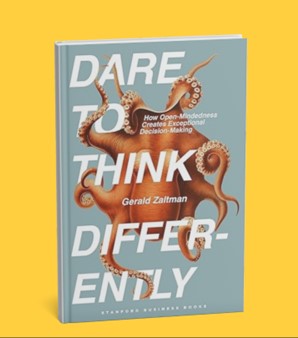
Here are four ideas that stood out as especially relevant for leaders, strategists, and insights professionals:

1. Embracing ambiguity
Jerry offered a deceptively simple idea: The primary job of a mind is to make meaning out of ambiguity.

We often treat ambiguity as a problem to eliminate. In strategy sessions and debriefs, the pressure is to “get clarity” quickly. But ambiguity is often where the opportunity lives. It’s where:

  • The next product idea is hiding
  • The overlooked emotional tension sits
  • The unexamined assumption operates

For those of us in insight roles, our job isn’t to prematurely tidy ambiguity. It’s to help organizations sit with it long enough to extract meaning.

2. Ignorance is where competitive advantage lives
Jerry said, “Ignorance is where the next competitive advantage is dwelling.”
 
Most organizations treat ignorance as something to conceal. In healthy cultures, it’s something to surface. When something feels unclear in a category or customer journey, that fog may be signal, not noise.
 
A few practical questions this suggests:

  • What are we missing?
  • What assumption are we not aware we’re making?
  • What piece of information would make this puzzle clearer?

Those questions alone can change how research is commissioned and how findings are used.

3. Imagination comes before creativity
Jerry drew a distinction I found clarifying:

  • Imagination is seeing what’s missing.
  • Creativity is making that idea workable.

We often treat creativity as the main event. But in his framing, creativity is an off-ramp from imagination – what makes an idea practical or executable.
 
Imagination comes earlier. It’s the ability to picture what could fill the gap in an ambiguous situation – to see what we don’t yet fully understand. Without imagination, creativity has nothing solid to build on.
 
For those of us working in research and strategy, that’s a useful reminder: before refining the solution, we have to ensure we’ve identified what’s actually missing.
 
Imagination requires sitting with ambiguity long enough to notice the gap – and that may be the harder discipline.

4. Thinking “like” vs. thinking “as” – the AI Question
Our conversation also turned to AI. Jerry described the difference between thinking “like” and thinking “as.”
 
AI can help us think like something – simulate patterns, accelerate analysis, generate language. But thinking as a human involves embodied, constantly shifting cognition that shapes imagination and meaning.
 
His warning was clear: AI can augment imagination and creativity, but it cannot replace them. The risk isn’t using AI – the risk is outsourcing imagination.
 
Taken together, these ideas are about ownership of thinking. Ownership shows up in how you:

  • Stay with ambiguity instead of rushing to clarity
  • Surface ignorance instead of hiding it
  • Strengthen imagination before jumping to execution
  • Use AI as a tool without surrendering judgment

When I asked Jerry why someone should read the book, he resisted giving a conventional benefit statement. Now I understand why. The book doesn’t hand you conclusions. It sharpens your ability to reach better ones.

You can watch the full interview here: https://www.youtube.com/watch?v=8H75GE1O91w

If you’re wrestling with an ill-structured problem and want to turn ambiguity into meaningful direction, I’d welcome a conversation. Contact me at info at bureauwest.com.

Sources: “From Insight to Impact: Interview with Gerald Zaltman,” 2/24/26; “Dare to Think Differently: How Open-Mindedness Creates Exceptional Decision-Making,” Gerald Zaltman, 2/24/26


How to Innovate

Innovation doesn’t always come from disruption; in many cases, it comes from a fresh look at something familiar. I was listening to an interview with Eric Ryan, the serial entrepreneur behind Method and Olly, and I was struck by his approach to innovation. He didn’t create billion-dollar brands by inventing entirely new categories. He did it by noticing what everyone else overlooked and making inspired tweaks in existing categories.

Olly – one of Eric Ryan’s ventures.
Source: https://www.olly.com/products/laser-focus

Ryan’s best-known ventures are great examples of his approach:

Method: Reinventing cleaning supplies. In the early 2000s, cleaning products were toxic, industrial, and hidden under sinks. Meanwhile, consumers were embracing design, wellness, and sustainability elsewhere in their homes. Ryan and his co-founder borrowed from personal care and housewares – fragrances, silhouettes, color – and brought them into cleaning supplies.

Olly: Turning vitamins into lifestyle products. Vitamins were treated like supplements for sick people – clinical, cluttered, and hidden in the cupboard. Olly flipped a couple conventions: ingredients were replaced with benefits (“Sleep,” “Beauty,” “Immunity”), packaging was designed to sit proudly on the counter, not hide in a cupboard. No new science, just new framing.

Wellie: Bandages with personality. Bandages used to hide. Wellie turned them into something fun, visible, and expressive, borrowing from fashion and kids’ products, not first aid.

Each brand succeeded not by inventing something new, but by reframing something old through a cultural lens.

How you can apply Ryan’s innovation principles:

  1. Look for sameness. If every brand in a category makes the same aesthetic and language choices, people are ripe for change.
  2. Find the cultural shift the category missed. Ask: What’s changed in people’s attitudes, aesthetics, wellness habits, design expectations, or values, and why hasn’t this category caught up? For example, Method caught the sustainability + design wave that personal care absorbed but cleaning supplies ignored.
  3. Steal ideas from faraway places. Don’t look at competitors. Look at food, architecture, children’s products, beauty, travel, digital culture – and translate what you see. Ryan once turned the texture of a building he saw in Tokyo into packaging inspiration. The farther the source, the fresher the translation.
  4. Change one big thing, not everything. Instead of layering small innovations, he picks one dramatic shift that creates instant contrast. Olly changed the shape and messaging on vitamin packaging – and instantly stood out. They didn’t make many changes to the category all at once, but rather started with one bold move.
  5. Pair the familiar with the unexpected. People need enough recognition to trust the product, and enough novelty to notice it. Method didn’t invent cleaning spray. They used the same function but redesigned the bottle, colors, and scent experience to feel more like personal care. Familiar product + unexpected execution = approachability and attention.

Using travel as a creative engine

One of the most distinctive parts of Eric Ryan’s process is how he uses travel, not as escape, but as stimulation. When he takes a “trend trip,” he brings designers with him. Everyone has something to hunt for: a color story, a display format, a materials idea, a scent, a tone of voice. They walk the stores, pay attention to what’s normal in that culture, and look for moments that surprise them.

At the end of the day, they meet – usually somewhere informal, like a pub – and compare what they spotted. But the key is what happens next: instead of filing photos away “for later,” they immediately send inspiration and notes to a creative team back home. While the travelers sleep, the team turns those observations into mockups and product concepts. By breakfast the next morning, they’re reviewing tangible ideas, not just impressions. In some cases, those concepts are pitched to retailers before the flight home.

It’s research, ideation, and prototyping collapsed into a 24-hour cycle. And it works because travel puts you back into a state of noticing.

While many believe innovation requires a blank slate, a lab, or a breakthrough technology, Ryan’s approach proves the opposite: you can create something meaningfully new by re-seeing what already exists. When we learn to spot sameness, listen for the cultural moment, steal from the right places, and make bold changes, innovation becomes practical rather than mystical. That’s how I like to work with clients: spotting overlooked signals, mapping cultural shifts and turning them into concepts quickly.

The raw materials for innovation are already in front of us, we just have to look with different eyes. If your team could use a fresh set of eyes or a structured way to spot the opportunities hiding in plain sight, I facilitate innovation sprints and co-creation sessions built around this kind of thinking. And if the idea of a curated trend trip sparks something for you, let’s explore that too.  Contact me at info at bureauwest.com .

Source: “Brainstorming $100M Ideas with the $1B+ King of Brands,” My First Million, Oct. 8, 2025

I facilitated a 6-hour Zoom session – and lived to tell the tale!

Source: https://www.pexels.com/photo/yelling-formal-man-watching-news-on-laptop-3760778/

Obviously, we’ve all been doing a lot of Zoom calls lately.  I’ve heard the term “Zoom fatigue” about how tiring those calls can be.  But I’ve wondered if they’re any more tiring than the in-person meetings we used to do.  I got an opportunity to contrast and compare: last year, I did a full-day in-person strategy session with a client (well, 6 hours, from 10am to 4pm).  This year, the same client needed to do another 6-hour session, but (of course) on Zoom.

It was indeed tiring, but there was an upside: when we took breaks, we were all in our own homes, so we got to take a true break, rather than just getting up and getting a cup of coffee with the other participants. 

Also, I had a few tricks up my sleeve and I was able to get some tips from my colleague Eric Snyder at Ignite 360, who had just done a full-day workshop with another client.  And it worked!  Everyone remained engaged throughout the day and we were able to get results!  (Though I will admit to being dead tired when it was done.)

Here are my tips for surviving a 6-hour Zoom session:

  • I scheduled a 15-minute coffee break in the morning, a 30-minute lunch and another 15-minute coffee break mid-afternoon – and I stuck to that schedule (politely cutting people off – it’s an art!).  So people didn’t have to go longer than an hour and 15 minutes to an hour and a half between breaks.
  • We did a few fun things throughout the day.  We sent some cookies and snacks to all the participants in advance which I encouraged the people to have during the coffee breaks and talk about which treats they liked best.  And rather than doing regular introductions, I had everyone send me the information about what they do at the organization, but also a little known fact about themselves and one or two photos of them doing something fun or unexpected.  I put them in a PowerPoint deck and used them as “palate cleansers” between topics.  I would first just show the little known fact and ask participants to guess who it was, and then revealed the person and their photos.  It really served to break up the day and lighten the mood.
  • Here’s something I didn’t do, but Eric has done with great results: offer small prizes for things like the first person to answer a certain question.  It could be as small as a $5 Starbucks card, but people love the competition!

In addition, I discovered some helpful points about how to best utilize Zoom’s features… and handle its shortcomings:

  • I knew it would be important for everyone to see each other speaking, so I asked them in advance to all use a computer and not a tablet (which only lets you view 9 participants at a time – we had 12) and definitely not a mobile phone.  And I made sure everyone was in Gallery Mode (or as I put it, “It should look like Hollywood Squares, where we are all in rectangles of the same size”).
  • I consider the chat panel an added bonus when compared to in-person discussions.  If someone has something to add to what a person is saying at that moment, they can type it in the chat panel, rather than interrupting.   Also, having two types of input – the voice of the person speaking and the text in the chat panel – actually helps people stay more engaged.  When you just listen to a person speaking, your attention is more likely to wander.
  • One of the drawbacks of Zoom is that when two people start talking at the same time, it takes a few seconds to realize that, and neither can be heard.  But the silver lining: it forces a more orderly discussion.  I had people raise their hands to indicate they wanted to speak next and I confirmed in the chat panel (e.g., “Next: Barbara”).  And when two people did start talking at once, I just had to play traffic cop and say something like “OK, Mary, you go ahead, and then David.”
  • We were planning to work together on crafting a vision statement and I had intended to share my screen so we could all agree on the text.  But I realized that participants wouldn’t be able to see each other that clearly while screen sharing.  Instead, I typed the suggested text in the chat panel, as well as subsequent revisions, until we had a version everyone agreed on.  (Note: that would be a good time to click the “save chat” link in Zoom!)

Let’s talk about the best approach to find the answer to your strategic questions. Call me at 760-469-9266 or email info at bureauwest.com.