Why interpretation matters more as AI gets better at listening.
For a long time, market research required a great deal of work simply to capture and make sense of what customers were saying – recruiting participants, conducting interviews and groups, transcribing conversations, coding responses and identifying patterns.
AI is making much of that faster and easier. It can capture conversations, organize large amounts of customer input, identify recurring themes and summarize what people are saying – often remarkably quickly.
Which raises the question: If AI can capture, organize and summarize customer input faster and more cheaply, how can we researchers still provide value to our clients?
I think the answer lies in interpretation. Because knowing what customers said is not the same as understanding what it means.
Interpretation can take many forms. It might mean recognizing that two seemingly contradictory findings reflect legitimate needs pulling customers in different directions. It might mean realizing that the reason customers give for a choice isn’t necessarily the factor actually distinguishing one option from another. Or it might mean seeing that a frequently mentioned issue is less important to the decision than a quieter finding that changes how we understand the whole situation.
In each case, the value isn’t simply in identifying the pattern. It’s in putting forward an explanation of what the pattern means and why it matters. What needs, values or competing priorities might explain what we’re seeing? What is the underlying story? And, perhaps most important, does that interpretation help make a decision clearer?
One simple way to make that jump is to treat an interpretation as a hypothesis rather than a conclusion. Instead of asking only “What did we hear?”, ask “What would explain why we heard this?” Then look back across the research for evidence that supports, complicates or contradicts that explanation.
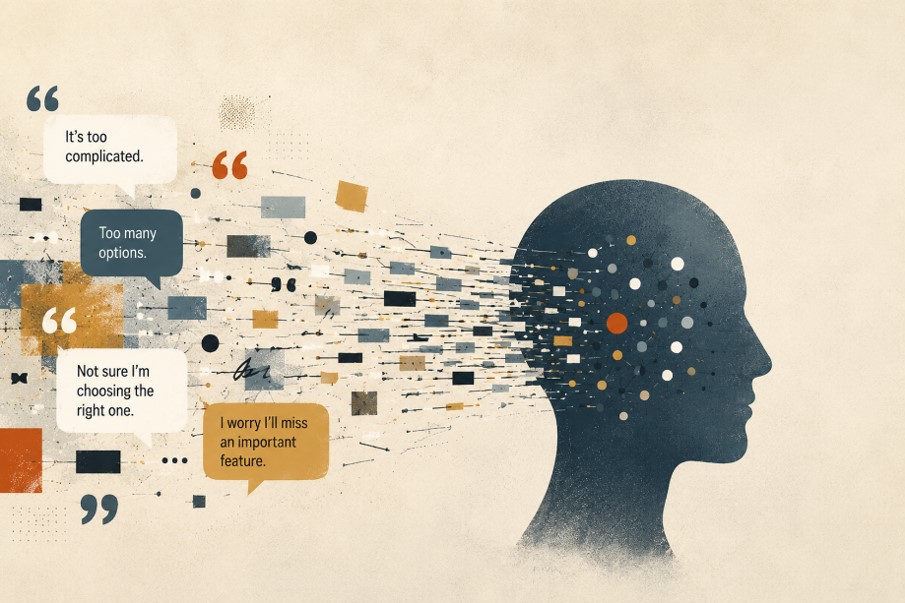
- For example, imagine customers repeatedly say that a company’s range of options feels overwhelming. The obvious conclusion might be that they want fewer choices. But perhaps, across the interviews, you also hear people worrying about missing an important feature, comparing options repeatedly, or wanting reassurance that they’ve made the right decision. That suggests a different interpretation: the problem may not be too much choice itself, but anxiety about choosing incorrectly.
- That distinction matters because it leads to a different response. Instead of simply reducing the number of options, the company might make choosing feel safer through better guidance, recommendations or reassurance.
A useful way to think about the process is:
- What did we hear?
- What might explain it?
- What else in the research supports or challenges that explanation?
- If we’re right, what should the client do differently?
That final question is an important test. If the interpretation doesn’t change how we understand the situation or what the client might do, we may still be describing the findings rather than interpreting them.
That’s also why interpretation is difficult to automate completely. AI can contribute, but interpretation requires judgment – deciding which patterns matter, testing possible explanations against the evidence, and taking a point of view about what the findings mean.
In other words, the researcher’s role may be shifting from primarily bringing the voice of the customer into the room to helping the organization understand what that voice is actually telling them.
I’ll be exploring that idea at the ESOMAR Congress 2026 in Valencia next week in a presentation called “Beyond the Voice of the Customer: The Rise of the Insight Interpreter.” It feels like an appropriate topic for a conference whose theme this year is Metamorphosis. Research is changing quickly. The opportunity is to make sure our role changes with it.
Do you have customer input that’s easy to summarize but harder to interpret? I’d be happy to help. Contact me at info at bureauwest.com