When AI Optimizes Everything, What Makes a Brand Different?

A closer look at where brand distinctiveness truly lives when optimization becomes table stakes.

In a recent TED Talk, Vinciane Beauchene asked a provocative question: If AI could take over all your team’s tasks tomorrow, who would you keep – and why? The talk reframes the “Will AI take our jobs?” anxiety, but as a marketer, that made me think of another question: If you removed your humans tomorrow, would your customers care… and why?

AI is rapidly becoming excellent at functional execution. It can optimize pricing, personalize recommendations, automate workflows, generate content, and coordinate across systems without fatigue. In many industries, that covers a surprising share of what we traditionally think of as marketing work. When everyone can execute at that level, functional excellence stops being a differentiator. And when optimization becomes table stakes, what makes customers choose you?

To answer that, it helps to step back and look at value in layers. Every company competes across three levels:

  • Functional value – speed, convenience, price, performance
  • Emotional value – how the experience makes customers feel
  • Identity value – what choosing you says about them

AI will compress functional advantages first. It will increasingly simulate emotional ones. The real strategic question is: where does your identity and trust equity live?

Let’s look at Costco as an example. At first glance, Costco looks purely functional. Low prices. Tight SKU selection. Supply chain efficiency. Those are all areas where AI can and will optimize aggressively.

But look deeper: emotionally, Costco creates the thrill of discovery. The treasure hunt effect. The feeling that you are getting access to something special and well curated. Customers feel smart shopping there. They feel protected from being ripped off.

At the identity layer, it goes further. Being a Costco member signals something. You are savvy. Practical. Not flashy, but informed. You belong to a tribe that values value. The membership card itself reinforces that identity.

Now imagine Costco becoming a perfectly frictionless, fully automated purchasing engine. No humans. No curated surprises. No in-store serendipity. Just optimized bulk fulfillment. It might be more efficient. But would it feel the same?

This is the risk many organizations face as they pursue AI. The danger isn’t that AI makes them worse. It’s that it makes everyone equally good at the functional layer, while unintentionally eroding the emotional and identity layers that drive loyalty.

Before automating aggressively, companies should ask:

  • Where does our differentiation truly live?
  • Which parts of our experience build emotional equity?
  • Where does human presence increase trust?
  • What would customers actually miss if it disappeared?

This isn’t a workforce exercise. It’s a customer understanding exercise. In the age of AI, the companies that win won’t simply automate more. They will automate wisely, while deliberately protecting and strengthening the human moments that anchor identity and trust.

If you’re exploring AI in your organization and want to understand where your differentiation truly lives across the functional, emotional, and identity layers, I’d be happy to talk about how we apply the Decoder Lens to uncover what your customers actually value – and what must stay human to protect it. Contact me at info at bureauwest.com.

Source: “Will AI take your job in the next 10 years? Wrong question,” Vinciane Beauchene, TED@BCG, October 2025

Customers don’t always want delight

I recently completed a post-booking survey for Expedia. One of the questions asked whether I felt “amazed” or “delighted” by the experience.

I paused. Not because the experience was bad – it wasn’t. It worked exactly as intended. I found a hotel, compared prices, booked it quickly, and moved on with my life.

But that was the point. I wasn’t hoping to be amazed. I wasn’t seeking delight. I was in task mode. I just wanted the process to work efficiently. That question felt off not because it was poorly worded, but because it revealed a deeper misunderstanding about how people actually experience value.

Many digital platforms – travel booking sites, airline apps, banking portals, insurance dashboards – are not emotional destinations. They are functional systems. Their primary job is to reduce effort, reduce uncertainty, and reduce time. When those systems work well, the dominant emotion isn’t delight. It’s relief. And relief is rarely measured.

Instead, many companies reach for aspirational language – delight, wow, magic – and then build surveys to validate those ideas. The problem is that when you ask emotional questions of a functional task, you don’t get insight. You get noise. Worse, you risk steering teams toward the wrong priorities: polishing moments that don’t matter while overlooking friction that does.

There’s a subtle but important difference between no emotion and no emotional work required. In many everyday buying contexts, people don’t want to be engaged – they want to be done. That’s not a failure of brand ambition; it’s an expression of buyer reality.

This is something I see repeatedly in my research. Emotion still matters, but it’s not always where companies expect it to show up. Often, the strongest positive signal isn’t excitement or delight, but quiet confidence that the system will do what it promises without getting in the way.

Sometimes, the best experience is the one you barely notice.

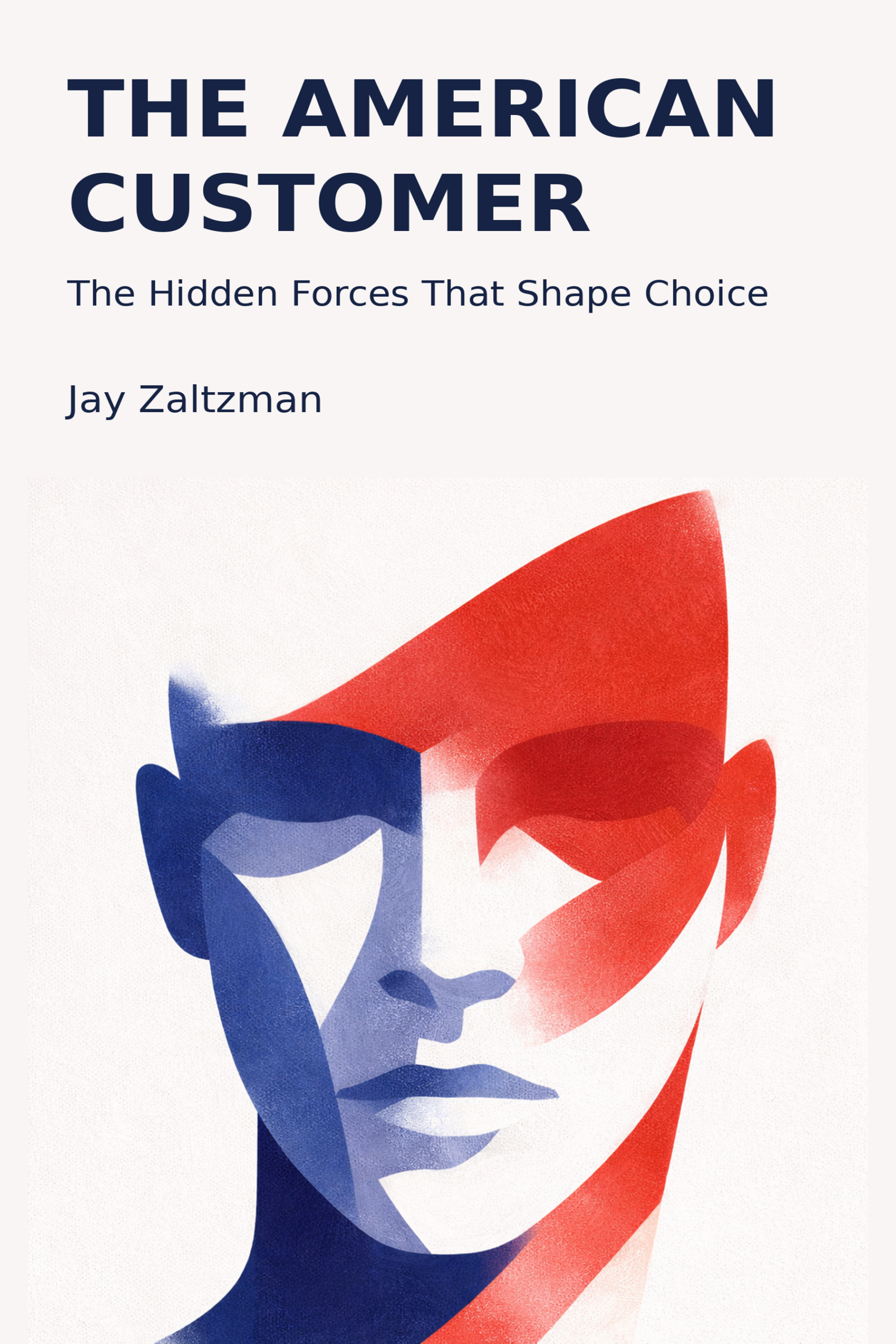
This pattern – and others like it – is a core theme in my upcoming book, Mind of the American Buyer, which looks at how people actually make decisions in the real world, rather than how brands imagine they do.

Curious where your customers are actually seeking delight – and where they just want things to work? You can reach me at info at bureauwest.com if you’d like to discuss the best way to understand that difference.

“We’re in the business of influencing other people”

When insight fails, it’s rarely because the research was wrong. More often, it’s because the insight never quite fit how decisions actually get made inside the organization.

That reality came through clearly in my recent From Insight to Impact video interview with Jinghuan Liu Tervalon, a senior marketing and insights leader with deep experience across CPG, food and beverage, and omnichannel retail. Her perspective offered a useful reminder: the value of research and the value of the research partner are tightly intertwined.

  • For Jinghuan, truly valuable research is first and foremost actionable – but not in the abstract sense the word is often used. In practice, that means explicitly tying insights to growth strategy and translating high-level ambition into concrete business terms. Growing penetration, for example, only becomes actionable when it’s reframed as a specific number of households, regions, or behaviors the organization can rally around.
  • She also pointed out that executives are often presented with research that’s difficult to decipher – dense conclusions, large volumes of data, or findings that stop short of clear direction. When that happens, even strong insight can lose momentum. Actionability depends not only on what the research says, but on whether senior stakeholders can quickly grasp what it means for the business and what to do next. Translation and clarity, not just rigor, are what keep insight moving.

This emphasis on clarity connects directly to how Jinghuan thinks about the role of research partners. She spoke enthusiastically about partners who proactively schedule pre-meetings to understand strategy, stakeholders, and success criteria. “I absolutely love the pre-meetings,” she said, noting that skipping that step often leads to disappointment later – even when the research itself is sound.

What makes her perspective especially valuable is how candid she was about the internal dynamics surrounding qualitative research. Like many insights leaders, she regularly encounters skepticism: “that’s not representative,” or “that’s just one person.” At the same time, she sees how qualitative work uniquely brings consumers’ lives, motivations, and tensions to life in ways numbers alone cannot.

This is where the role of the qualitative research partner becomes inseparable from the value of the research itself. Jinghuan doesn’t just want partners who deliver insight – she values partners who help her influence. Insights teams don’t own activation; marketing and sales do. Their job is to persuade others to trust and act on what the research reveals.

  • “We’re not in charge of marketing activation. We’re here to provide data and insights and recommendations. Fundamentally we’re in the business of influencing other people. So the soft skills are really, really critical.”

When qualitative partners help convey the value of qualitative insight internally, they’re not overstepping – they’re sharing a very real burden.

A good research partner needs marketing fluency, organizational awareness, and an understanding of how stakeholders prefer to receive and challenge information. Partners who can speak the language of growth, brand, and activation dramatically increase the odds that insight won’t end up admired once – and then quietly shelved.

The takeaway is deceptively simple: research creates impact not just because it’s insightful, but because it’s designed to be understood, trusted, and acted on inside the organization. And in that sense, “valuable research” and a “valuable research partner” are often one and the same.

Want research that will be understood, trusted, and acted on inside your organization? Contact me at info at bureauwest.com and let’s talk through the best approach.

Source: “From Insight to Impact: Interview with Jinghuan Liu Tervalon,” 12/23/25

Even experts need help choosing

Experienced customers are often unsure how to choose; the opportunity for marketers is to guide them with clarity.

In a recent project about how tennis players choose tennis balls, one of the most striking findings wasn’t about durability or bounce. It was about confidence. Even experienced players – people who have played for years and know the sport inside-out – told us they don’t really know how to choose a tennis ball. They’re confident on the court, but not in front of the shelf.

  • What they do know is which balls the pros use. And that becomes the anchor for their own choices. If the top-tier “professional” ball feels too expensive, they often pick the next version from the same brand, assuming it must be similar enough. The nuances of felt type, bounce characteristics, or durability rarely play a central role. Instead, players rely on borrowed expertise.

Tennis is just the entry point to a larger phenomenon: expertise in using a product does not necessarily translate into expertise in choosing it.

This gap is wider today than ever. Shoppers face more information than they can reasonably absorb across the many domains of their lives. Every category has its own specs, rankings, reviews, and jargon. People simply don’t have the bandwidth to stay on top of all of it. So even experienced users – people who know the activity well – may feel underqualified when navigating the marketplace. In that context, relying on shortcuts becomes not just common but rational. Borrowing the judgments of pros, brands, or other trusted sources helps buyers reach a confident decision quickly.

  • We see this across categories. A skilled home cook might pick pots and pans based on what a celebrity chef endorses. A long-time runner may choose shoes because elite marathoners wear them. A serious hobby photographer often selects equipment based on a professional’s recommendation rather than the features that truly match their own needs.
  • This same dynamic shows up in B2B. Business buyers are experts in their fields but not necessarily in the specific products they’re evaluating. A manufacturing executive may know operations inside-out yet still defer to analysts, integrators, or the industry’s “market leaders” when selecting software or equipment. A procurement team may lean on vendor tiering or Gartner rankings because it feels safer than decoding dense technical sheets.

The broader insight: buyers often want reassurance more than mastery. In a world of overwhelming information, feeling confident matters more than knowing every detail.

For marketers, this insight creates several opportunities:

  • Make the choice architecture intuitive. Use naming, packaging, and product tiers that clearly signal who each option is for.
  • Provide simple heuristics. Offer clear starting points: “If you value X, start here.”
  • Translate expert logic into everyday language. Emphasize what each feature does for the customer.
  • Clarify your product ladder. Highlight step-up benefits and trade-offs.

The takeaway: Your customers don’t need to become experts. They need to feel they’re making a smart, safe choice – and they’ll gladly borrow your expertise if you offer it in a clear, human way.

Want to help your customers make the right choice? Email me at info at bureauwest.com.