Wellness Thinking – The New Consumer Default

Marketers tend to think of “health and wellness” as a category. But for many consumers, it has become a worldview – a filter they use to evaluate nearly every part of life, from how they shop to how they work and spend time online.

Today, wellness isn’t just about smoothies and supplements. It’s about living with balance, protecting mental space, and feeling in control. And that shift is quietly redefining what people expect from every brand, not just those in the health sector.

This shift toward wellness as worldview isn’t just cultural, it’s psychological. The way people define “healthy” now overlaps with how they define “good design,” “trustworthy brand,” and “worth my time.” Below, I outline three big mindset changes driving that overlap: how people filter everyday experiences through emotional wellbeing, how they seek balance over intensity, and how they treat calm and longevity as modern status symbols.

Wellness as a lens on daily life

Recent consumer research finds that most people now see wellness as a continuous, personalized practice rather than a set of isolated activities. It’s not limited to diet, exercise, or meditation – it’s about how every choice affects energy, focus, mood, and a sense of control.

  • For many, wellness shows up in small, everyday decisions: choosing a digital service that doesn’t bombard them with notifications, preferring retailers that feel calm and organized, or seeking travel experiences that help them recharge instead of overschedule. Even outside the wellness industry, people now notice whether brands add to their equilibrium or disturb it.
  • This means that every interaction – a checkout flow, a customer-service email, a loyalty program – is being subconsciously evaluated for its emotional effect. Frustration, confusion, or overwhelm feel like costs; clarity and ease are benefits.
  • Takeaway: To resonate, brands need to feel restorative rather than draining. Streamlined design, transparent pricing, and gentle communication cues (like pauses, reassurance, or clear summaries) convey emotional intelligence. Even minor friction – a confusing menu, a manipulative pop-up – signals that a company is out of sync with modern consumer values.

Finding balance

Earlier waves of wellness culture celebrated optimization: faster, stronger, leaner, “10X better.” But as burnout and overstimulation have become part of everyday life, many consumers now define wellness as balance and boundary-setting rather than endless striving.

  • Gen Z in particular blends wellness with self-protection. Routines such as digital detoxes, mindfulness breaks, and prioritizing rest are less about peak performance and more about managing inputs and maintaining stability. People are increasingly skeptical of brands that encourage overextension or perpetual urgency.
  • Instead, they value products, services, and experiences that simplify decisions and help them manage attention, time, and mental load. A software platform that makes workflows less chaotic, a retailer that organizes choices clearly, or a financial app that reduces anxiety all meet the deeper need for self-regulation.
  • Takeaway: Marketers outside wellness can translate this by designing experiences that remove friction and return control to customers. Replace “act now” messaging with “take a moment” language. Frame tools and services as ways to protect time, not consume it. The brands that feel like partners in calm, not triggers for pressure, will win loyalty in an age of cognitive overload.

Status through mental peace

Wellness has also become a new marker of success. Where past generations signaled status through accumulation or busyness, today’s symbols of prestige are emotional composure, longevity, and mental peace.

  • Cultural conversations about longevity – from biohacking and anti-aging supplements to sleep tracking and stress reduction – show that people increasingly equate being in control of their wellbeing with intelligence, responsibility, and even moral worth. To “age well,” “stay calm,” or “future-proof yourself” communicates discernment.
  • For affluent consumers, longevity is the new luxury. For everyone else, balance is aspirational. Calm confidence signals power in a chaotic world. Brands that help people feel centered, future-ready, and emotionally steady tap into a powerful new form of aspiration – one less about status display and more about self-possession.
  • Takeaway: Marketers can align with this by showing how their offerings support agency and composure. Position products as tools for protecting future wellbeing (“set yourself up for tomorrow”), use serene visual language, and highlight clarity and trustworthiness. The emotional promise is not “we’ll energize you” but “we’ll help you stay grounded.” In a culture overwhelmed by acceleration, calm itself has become aspirational.

What this means for marketers:

  • Design for emotional climate. Treat your website, store, or service flow as part of your customer’s mental landscape. Test for stress as rigorously as you test for usability.
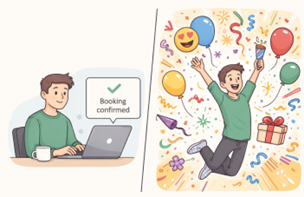
  • Build micro-restorative moments. A clear confirmation message or a well-timed pause can have the same psychological impact as a breath in meditation.
  • Make balance the hero. Replace narratives of busyness and optimization with ones of clarity, control, and sustainable progress.
  • Connect with the “future-self” story. Help customers feel they’re investing in a version of themselves who’s calm, capable, and well.
  • Show transparency and steadiness. A composed tone and visible integrity are today’s trust signals.

Wellness is no longer a niche; it’s the emotional infrastructure of modern life. Every brand is now part of someone’s wellbeing ecosystem – whether intentionally or not. Make sure your brand contributes to your customers’ well-being rather than increasing their stress. Let’s discuss how to do that! Contact me at info at bureauwest.com .

Sources: McKinsey & Company “Future of Wellness 2025”, NielsenIQ “Global State of Health & Wellness 2025”, Euromonitor “Healthy Longevity and Embedded Wellness Lifestyles”, Vogue Business “2025’s Hottest Trend: Living Longer”

“Companies are data-rich but information-poor”

My second From Insight to Impact video interview was with Justin Amendola, a senior marketing and strategy executive with a great deal of experience in the digital field, most recently at Meta. We talked about how companies can get more value from insights. One quote from Justin stuck with me: “Most companies are data-rich and information-poor.” It’s a striking observation that connects to everything we discussed.

The conversation crystallized three ideas for me: that impact begins with alignment, that courage means knowing when to listen and when to lead, and that AI will redefine, not replace, the human side of insight.

1. Aligning across teams

Justin’s first recommendation was simple but powerful: get the right people in a room early in the year. Invite leaders from marketing, product, and sales to share their top five priorities. Then look for the overlap. “Even if only two or three priorities align,” he said, “that’s where you start.”

It’s such a practical way to make research more useful. Instead of insights being delivered into a vacuum, they’re designed around shared goals from the beginning. As Justin put it, when teams align on questions upfront, they’re more likely to use the answers all year long.

And for those of us who work with clients, this is something we can offer: to facilitate that kind of alignment session. Helping teams clarify what insights they’ll need may be just as valuable as providing the insights themselves.

2. Knowing when to listen and when to lead

Justin also shared a candid story about a digital product launch that didn’t go as planned. The research made it clear that customers weren’t ready for the new apps, but leadership pushed ahead anyway. Six months later, several of the apps were quietly shelved.

It’s a story many of us have seen play out in different forms. Of course, marketers can point to famous counter-examples, like the Sony Walkman, where customers said “no” in testing, but loved the product once it was launched. So how do you know when to move forward and when to pause?

Justin’s take: timing and readiness matter. “Even great ideas fail when the market isn’t ready,” he said. Sometimes a hunch is right, but early. Our role as researchers is to help leaders discern which situation they’re in. That might mean reframing the question, testing the why behind hesitation, or helping teams recognize when it’s time to pivot instead of push.

3. Humans + AI: the next chapter for insights

Finally, we talked about how AI is changing the field. Justin’s perspective was refreshing: “Researchers should think of AI as a complement, not competition.” He believes humans still have an edge in understanding context – especially emotional and cultural nuance. AI can process the data, but people translate it into meaning.

In the future, research teams may become leaner but more impactful, focusing on the 20 percent of work that adds the most value. With AI handling the heavy lifting, we’ll have more time for what humans do best: connecting the dots, telling stories, and understanding what people truly care about.


What struck me most from our conversation is that the role of the researcher is expanding. We’re not just interpreters of data – we’re facilitators, truth-tellers, and translators between information and action.

Whether it’s aligning teams, balancing conviction with evidence, or partnering with AI, our job is to help organizations turn all that data into wisdom.

You can view the full interview with Justin, as well as future interviews, on my YouTube channel here.

Let’s talk about how to generate insights that will benefit your organization. Contact me at info at bureauwest.com.


Source: “From Insight to Impact: Interview with Justin Amendola,” Bureau West, 10/8/25

Luxury’s emotional shift and what every brand can learn from it

For decades, luxury operated under a single narrative: heritage, scarcity, and status by distance. That used to work because culture was more centralized: Paris, Milan, London, New York. Prestige signaled the same thing to everyone.

Not anymore. Today’s luxury buyers aren’t responding to a single idea of “the good life.” They’re chasing meaning, identity, experience, creativity, and sometimes rebellion. The signals of desire have splintered. What used to feel aspirational can now feel generic, or worse, out of touch.

  • And while luxury is feeling this shift first, any brand that relies on identity, aspiration, or premium pricing is moving into the same terrain.

This conceptual shift maps to different psychological storylines. Five of the most powerful expressions of luxury today are showing up like this:

  • Explorer luxury tied to experience, individuality, and discovery. Aman Resorts is a perfect example, selling seclusion and personal immersion rather than opulence for display.
  • Creator luxury fueled by artistry, innovation, and co-creation. Bottega Veneta demonstrates this with “quiet” craftsmanship and design-led identity instead of logos.
  • Lover luxury centered on sensuality, intimacy, and self-expression. La Perla embodies this through luxury that’s felt on the body, not broadcast to others.
  • Connoisseur luxury rooted in discernment, depth, and cultivated understanding. Hermès plays here, appealing to people who value mastery without fanfare.
  • Outlaw luxury defined by rebellion, provocation, and cultural subversion. Balenciaga has built its relevance by breaking aesthetic rules while commanding high luxury pricing.

Brands that cling to a single inherited definition of luxury risk becoming invisible to the very consumers driving the market.

Here are four strategic pivots any luxury brand can act on, and they apply to any brand driven by meaning, identity, or aspiration.

  • Decide what kind of desire you represent. Don’t rely on default prestige cues. Clarify whether your version of luxury is about mastery, creativity, seduction, exploration, transformation, or authority, and build around it.
  • Replace distance with depth. Exclusivity doesn’t have to mean aloofness. Private client experiences, cultural collaborations, and insider access deliver status through intimacy rather than separation.
  • Localize without losing your center. Cultural authority isn’t owned by one region anymore. The future belongs to brands that adapt expression to different markets without diluting identity.
  • Let people participate in the story. Younger luxury buyers don’t just want to own something rare, they want to shape it, remix it, or see themselves in it. Drops, co-designed capsules, and digital-first touchpoints reward involvement instead of worship.

Luxury is no longer defined by a single narrative. The opportunity is not to abandon the roots of luxury, but to declare which emotional territory you own now.

And while this shift is most visible in luxury, the pattern is already spreading. Any brand that focuses on meaning or aspiration faces the same choice. The brands that will stay relevant aren’t the ones with the longest history. They’re the ones with the clearest identity.

If you’d like help clarifying which emotional territory your brand occupies – or should occupy – I’d love to help. Contact me at info at bureauwest.com

Sources: “A new vocabulary for luxury: The nine archetypes defining its future,” Luxury Daily, October 13, 2025; Bureau West research and analysis

How to Innovate

Innovation doesn’t always come from disruption; in many cases, it comes from a fresh look at something familiar. I was listening to an interview with Eric Ryan, the serial entrepreneur behind Method and Olly, and I was struck by his approach to innovation. He didn’t create billion-dollar brands by inventing entirely new categories. He did it by noticing what everyone else overlooked and making inspired tweaks in existing categories.

Olly – one of Eric Ryan’s ventures.
Source: https://www.olly.com/products/laser-focus

Ryan’s best-known ventures are great examples of his approach:

Method: Reinventing cleaning supplies. In the early 2000s, cleaning products were toxic, industrial, and hidden under sinks. Meanwhile, consumers were embracing design, wellness, and sustainability elsewhere in their homes. Ryan and his co-founder borrowed from personal care and housewares – fragrances, silhouettes, color – and brought them into cleaning supplies.

Olly: Turning vitamins into lifestyle products. Vitamins were treated like supplements for sick people – clinical, cluttered, and hidden in the cupboard. Olly flipped a couple conventions: ingredients were replaced with benefits (“Sleep,” “Beauty,” “Immunity”), packaging was designed to sit proudly on the counter, not hide in a cupboard. No new science, just new framing.

Wellie: Bandages with personality. Bandages used to hide. Wellie turned them into something fun, visible, and expressive, borrowing from fashion and kids’ products, not first aid.

Each brand succeeded not by inventing something new, but by reframing something old through a cultural lens.

How you can apply Ryan’s innovation principles:

  1. Look for sameness. If every brand in a category makes the same aesthetic and language choices, people are ripe for change.
  2. Find the cultural shift the category missed. Ask: What’s changed in people’s attitudes, aesthetics, wellness habits, design expectations, or values, and why hasn’t this category caught up? For example, Method caught the sustainability + design wave that personal care absorbed but cleaning supplies ignored.
  3. Steal ideas from faraway places. Don’t look at competitors. Look at food, architecture, children’s products, beauty, travel, digital culture – and translate what you see. Ryan once turned the texture of a building he saw in Tokyo into packaging inspiration. The farther the source, the fresher the translation.
  4. Change one big thing, not everything. Instead of layering small innovations, he picks one dramatic shift that creates instant contrast. Olly changed the shape and messaging on vitamin packaging – and instantly stood out. They didn’t make many changes to the category all at once, but rather started with one bold move.
  5. Pair the familiar with the unexpected. People need enough recognition to trust the product, and enough novelty to notice it. Method didn’t invent cleaning spray. They used the same function but redesigned the bottle, colors, and scent experience to feel more like personal care. Familiar product + unexpected execution = approachability and attention.

Using travel as a creative engine

One of the most distinctive parts of Eric Ryan’s process is how he uses travel, not as escape, but as stimulation. When he takes a “trend trip,” he brings designers with him. Everyone has something to hunt for: a color story, a display format, a materials idea, a scent, a tone of voice. They walk the stores, pay attention to what’s normal in that culture, and look for moments that surprise them.

At the end of the day, they meet – usually somewhere informal, like a pub – and compare what they spotted. But the key is what happens next: instead of filing photos away “for later,” they immediately send inspiration and notes to a creative team back home. While the travelers sleep, the team turns those observations into mockups and product concepts. By breakfast the next morning, they’re reviewing tangible ideas, not just impressions. In some cases, those concepts are pitched to retailers before the flight home.

It’s research, ideation, and prototyping collapsed into a 24-hour cycle. And it works because travel puts you back into a state of noticing.

While many believe innovation requires a blank slate, a lab, or a breakthrough technology, Ryan’s approach proves the opposite: you can create something meaningfully new by re-seeing what already exists. When we learn to spot sameness, listen for the cultural moment, steal from the right places, and make bold changes, innovation becomes practical rather than mystical. That’s how I like to work with clients: spotting overlooked signals, mapping cultural shifts and turning them into concepts quickly.

The raw materials for innovation are already in front of us, we just have to look with different eyes. If your team could use a fresh set of eyes or a structured way to spot the opportunities hiding in plain sight, I facilitate innovation sprints and co-creation sessions built around this kind of thinking. And if the idea of a curated trend trip sparks something for you, let’s explore that too.  Contact me at info at bureauwest.com .

Source: “Brainstorming $100M Ideas with the $1B+ King of Brands,” My First Million, Oct. 8, 2025