Better Qualitative Analysis with AI

We know AI can save researchers time. It can generate transcripts in minutes, cluster quotes into themes, and even draft summaries. That’s useful, but even more important, can AI make the analysis better and more valuable to clients? I think it can.

Here’s how:

Moving beyond speed to depth. Traditional analysis often stops at description: “Here’s what participants said.” With limited time, it’s easy to get stuck at that level. AI can free us from the mechanical work so we can push deeper – to why certain comments matter, what patterns emerge, and where tensions lie.

Seeing what humans might miss. AI excels at scanning vast amounts of text and surfacing signals we might overlook. It can flag contradictions, unusual word choices, or subgroup differences that don’t immediately catch the eye. The researcher then brings judgment and context to interpret what these signals mean. Together, it’s a more robust analysis than either could do alone.

  • Of course, we need to know to ask AI for these things. For example, “were there any situations where a participant contradicted something they said previously?” Or “were there any differences of opinion between segment x and segment y?”

Challenging assumptions more systematically. One of the most valuable roles of qualitative research is to challenge client assumptions. But – though I hate to admit it – we researchers also have assumptions and biases. AI can help us make sure we aren’t swayed by the most memorable participants and don’t forget some of the quieter exchanges.

  • I ask AI to check my assumptions as well as those of my clients. I might ask “did most participants prefer x?” and be surprised when it turns out that I was just remembering a vocal minority and many participants actually didn’t feel that way. And of course, AI analysis can easily back up these statements with quotes. So if we need to tell our clients that the findings did not match their assumptions, we can provide proof!

Strengthening implications. Clients don’t just want findings; they want implications. AI can assist by drafting preliminary “implication statements” from the data clusters it identifies. The researcher then sharpens these into strategic recommendations. This combination helps ensure that insights aren’t just descriptive, but actionable.

  • I like to work with AI as a kind of brainstorming partner and challenge its suggestions. That back-and-forth discussion can result in stronger implications.

When AI takes on the mechanics of coding and clustering, the researcher’s role shifts upward: from data wrangler to meaning-maker, from summarizer to strategist. That shift is where qualitative research delivers its greatest value. The key is not to let AI do the thinking for us, but to let it clear space and surface signals so we can do the thinking that matters most.Let us provide our thinking for your research needs! Contact me at info at bureauwest.com and let’s discuss how to best answer your research questions.


Cultural pitfalls when selling to US customers

From the outside, the US can look like a wide-open market: large, affluent, and English-speaking. But many international brands have learned the hard way that what works at home doesn’t always land with American customers. Even globally sophisticated companies have stumbled by overlooking cultural cues, customer expectations, or just how different the US really is.

Some examples:

  • When UK supermarket giant Tesco launched Fresh & Easy in the Western US, it assumed American shoppers would embrace smaller stores, self-checkout, and ready-made meals, just as they had in Britain. But they didn’t. Americans tend to shop less frequently and buy in bulk. Self-checkout kiosks (a core feature of the concept) felt impersonal. And the grab-and-go prepared foods? Not what many families were looking for in a weekly grocery haul. After five years and nearly $2 billion in losses, Tesco pulled out of the US entirely.
  • Danish pharma company Novo Nordisk saw enormous opportunity in launching its weight-loss drug Wegovy in the US But it didn’t fully anticipate just how fragmented and cost-sensitive the American healthcare system is. The marketing was strong, but the product wasn’t widely available. Supply was limited. Insurance coverage was patchy. And out-of-pocket costs could exceed $1,300/month. The result was frustration from patients and physicians, negative press, and a loss of ground to US competitor Eli Lilly.

What went wrong? In both cases, the companies entered the US with strong brands, solid products, and proven models. What they lacked was a deep understanding of American customers.

Here are just a few misconceptions that frequently trip up international companies:

  • “The US is one market.” In reality, it’s a patchwork of regional, cultural, and socioeconomic submarkets.
  • “What works in Europe will work in the US” American expectations around convenience, customer service, and speed are often much higher.
  • “Subtle, nuanced messaging will be appreciated.” US marketing norms favor directness, boldness, and clarity.
  • “If we build it, they will come.” Without understanding US shopping behaviors or systems (like insurance or retail logistics), even great products can falter.

These are the kinds of missteps that deeper qualitative research can help prevent. To understand American customers – not just what they do, but why – foreign companies need research that reveals cultural nuance.

Here are some research approaches that can help:

  • In-home or remote ethnography. Observe daily routines and behaviors. This would have revealed that “quick convenience meals” don’t mean the same thing to US families as to UK shoppers. This can be done in-person or using an online platform such as Field Notes (https://www.fieldnotes.space/) or a combination of the two.
  • Storytelling and projective interviews. Ask people to talk about their earliest memories related to your product or service, their best or worst experiences, and their ideal experience. This uncovers the values and emotional drivers behind their decisions.

And don’t forget to test assumptions across American submarkets (urban vs. suburban, East vs. West Coast). What resonates in Seattle may not play the same in Houston.

It’s easy to underestimate how culturally specific customer expectations can be, especially in a country that looks, on the surface, familiar. But the gap between looks familiar and feels right is where brand traction is won or lost. That’s where qualitative research makes all the difference. If you’re entering or struggling to grow in the US market, we can help. Contact me at info at bureauwest.com and let’s discuss!

Sources: “How Novo Nordisk misread the US market for its weight loss sensation,” Reuters, July 1, 2025; “Tesco will pull out of U.S., sell Fresh & Easy,” USA Today, April 17, 2013

The insight you didn’t ask for – but needed most

Sometimes, market research seems to lead companies in the wrong direction. One famous example: Coca-Cola’s launch of New Coke. Research participants said they liked the taste better. The data backed it up. But what the company missed was the depth of emotional connection consumers had to the original – its familiarity, its identity, even its nostalgia. Within months, Coke was flooded with protests and had to reverse course. Then there’s Tropicana, which redesigned its packaging in 2009 – removing the familiar orange with a straw in favor of a more minimalist look. The response? A 20% drop in sales in just a few weeks. Not because the juice changed, but because the emotional cues customers relied on had vanished from the shelf.

But was the research wrong – or were they asking the wrong questions?

Almost every project begins with clear, focused questions. Sounds smart – however, participants frequently provide important insights about something entirely different. But if it’s not in the discussion guide, it’s often ignored.

That kind of thing happens often. For example:

  • A tech client wanted customer input on a new feature, but customers said they really want the existing features to be easier to use.
  • A bank wanted to learn how personal advisors could be most helpful to customers with high balances; however, the customers weren’t interested in a personal connection – they just wanted faster service and better rates.
  • A food company conducted testing on different flavors of their product, but customers had greater concerns about making sure the ingredients were “clean.”

The problem is, when participants tell us what they really want, if it doesn’t fit with the research brief, their remarks are frequently treated as “off-topic.” But they have the potential to be strategic gold. They may lead to opportunities that should not be ignored.

As a result, I’ve developed what I call the “Opportunity Layer.” It’s an approach that makes sure we don’t ignore:

  • What customers bring up without prompting.
  • What truly matters to them, beyond the discussion guide.

How the Opportunity Layer works:

  • During qualitative sessions, we make space to follow the energy, nuance, and emotions that come up, not just the guide.
  • Analysis includes the stated objectives as well as the unexpected input, with the resulting report including answers to the brief as well as the Opportunity Layer – what showed up beyond the brief.
  • We conduct a facilitated debrief with stakeholders to discuss results and potential strategic pivots.

Benefits for clients:

  • Discover blind spots you didn’t know existed.
  • Prevent initiatives built on incomplete understanding.
  • Gain richer strategic perspective on customer needs and motivations.

Could the Opportunity Layer uncover strategic gold for your company? Contact me at at info at bureauwest.com and let’s discuss!

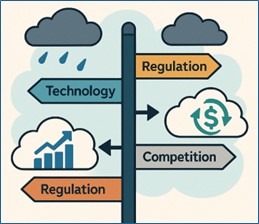
Strategic readiness when times are uncertain

That uncertainty you’ve been feeling – it’s not just you! Last month, the CEO confidence index experienced its sharpest quarterly decline since its inception in 1976. Companies are used to planning for a future that is at least somewhat similar to the present, but today more than ever, that is not necessarily the case.

So what to do in this situation? Scenario planning may be the perfect approach.

Scenario planning is a strategic method for exploring multiple plausible futures, based on a combination of current trends, driving forces, and critical uncertainties. Unlike forecasting, scenario planning isn’t about trying to guess what will happen. Instead, it’s a way of exploring what could happen – so you’re better prepared, no matter what the future brings.

At its heart, scenario planning is a process that helps teams stretch their thinking beyond the default assumptions. The process usually starts with a simple but essential question: What are the biggest uncertainties that could affect our business in the next 2–5 years?Typically, we conduct interviews with stakeholders and opinion leaders to generate a list of those uncertainties.

We then engage stakeholders in a workshop to further explore the most critical uncertainties and devise scenarios for them. In the workshop, we delve deep into the signs to watch for such as shifts in buyer behavior, economic trends, and more. Armed with this information, we work together to devise strategies for preparing your organization for them.

Could scenario planning be helpful for your organization? I’ve partnered with fractional CMO and strategist extraordinaire Beth VanStory in order to offer clients the whole scenario planning process, including research, workshop, analysis and strategy development. See more about Beth here and contact me at info at bureauwest.com to discuss further.

Source: “CEO Confidence Plummets as Tariffs Take a Toll,” Wall Street Journal, 5/29/25